A sales team loses track of follow-ups in one system while operations chase stock levels in a spreadsheet and finance exports data from somewhere else entirely. That is usually when the ERP vs CRM software question stops being theoretical and starts costing time, margin and patience.
For growing SMEs, this is not really about software categories. It is about control. If your customer data sits in one place and your operational data sits in another, decisions slow down, errors increase and people start building workarounds. No jargon, no judgment – that is the reality many businesses face before they put the right platform in place.
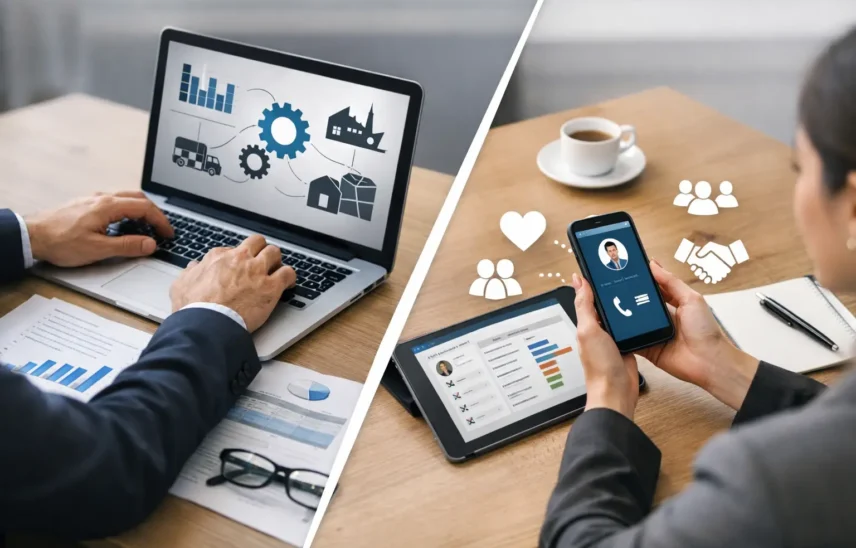
The simplest way to separate them is this. CRM software helps you manage customer relationships, sales activity and communication. ERP software helps you run the wider business, including finance, stock, purchasing, operations, fulfilment and reporting.
A CRM is usually customer-facing in its logic. It tracks leads, quotations, calls, emails, account history and sales pipelines. If your biggest pain point is missed follow-ups, poor visibility of opportunities or inconsistent account management, CRM is often the first gap to close.
An ERP is broader and more operational. It connects the processes that sit behind the sale. That may include inventory, order processing, supply chain activity, project costing, finance and management reporting. If your issue is not winning the work but delivering it efficiently and profitably, ERP tends to matter more.
That said, the line is not always neat. Many ERP platforms include CRM functions, and many CRM platforms offer workflow, quoting and light operational tools. The right decision depends on how far your business needs the system to go.
CRM earns its place when sales and service teams need a single, reliable picture of every customer interaction. It gives structure to pipeline management, helps teams record calls and emails properly, and makes forecasting less dependent on one person’s memory.
For a professional services firm, that might mean seeing every conversation, proposal and renewal date in one place. For a retail or distribution business, it might mean tracking account managers’ activity across multiple customer accounts and making sure no order opportunity goes cold.
Used well, CRM improves responsiveness. It can shorten sales cycles, support better handovers and give managers a clearer view of what is likely to land next month rather than what people hope will land. It is especially useful where growth has outpaced informal processes.
The trade-off is that CRM will not fix broken back-office workflows on its own. It can tell you a customer is ready to order, but if stock, pricing, fulfilment or invoicing still depend on disconnected systems, the bottleneck simply moves further down the line.
ERP comes into its own when businesses need one operational system rather than a patchwork of tools. It is designed to connect the moving parts that affect cost, delivery and control.
In manufacturing, that may mean linking purchasing, stock, production planning and finance. In logistics or supply chain environments, it often means visibility across orders, goods movement, supplier performance and margin. In education or professional services, it may centre on resource planning, billing and reporting rather than physical stock.
ERP is valuable because it reduces duplication. Teams stop rekeying information from one system into another. Reporting becomes more credible because the figures come from the same source. Finance can close periods faster, operations can spot issues earlier, and management can make decisions without waiting for someone to clean up three versions of the same spreadsheet.
The trade-off is complexity. ERP usually requires more planning, clearer processes and stronger internal ownership than a straightforward CRM rollout. If a business has not agreed how it wants to work, a new ERP system can expose that quickly.
Not every SME needs ERP straight away. If your business is mainly focused on winning work, managing relationships and keeping account management consistent, CRM may be the right starting point.
This is often true for firms with relatively simple fulfilment models. If you do not hold much stock, do not run complex purchasing cycles and do not need detailed operational reporting, a CRM can solve the most immediate commercial issues without adding unnecessary weight.
It is also a sensible first step when teams have no shared process around leads, quotes and follow-up. Putting structure around the front end of the customer journey can deliver quick gains. Better visibility, cleaner forecasting and fewer missed opportunities can have an immediate effect on revenue.
But it is only enough if the rest of the business can cope. Once order volumes rise, service delivery becomes more complex or finance needs stronger control, CRM on its own can start to look like half a solution.
ERP usually becomes the better investment when growth creates operational drag. The warning signs are familiar. Stock levels are unreliable. Teams are entering the same data twice. Reporting takes too long. Customer promises depend on someone checking three systems and a spreadsheet before giving an answer.
At that point, the business needs more than a better sales database. It needs joined-up processes. ERP can provide that by bringing together commercial, financial and operational data into one environment.
For SMEs in logistics, manufacturing and supply chain in particular, this matters because small inefficiencies quickly become expensive. Poor stock visibility ties up cash. Manual order handling creates errors. Slow reporting delays decisions. ERP helps create a more controlled operating model, which is often the difference between coping with growth and being held back by it.
Quite often, yes. The real question is whether you need two separate systems or one platform that covers both areas well enough.
Businesses with active sales teams and complex fulfilment usually need both customer relationship management and operational control. A sales team needs pipeline visibility, communication history and quote management. Operations and finance need accurate stock, purchasing, invoicing and reporting. If those functions are disconnected, the customer experience suffers even if each team thinks it is doing its job properly.
This is why integration matters so much. When CRM and ERP work together, sales can see what has been ordered, operations can see what has been promised and leadership can track performance across the full customer lifecycle. That means fewer handover issues, less duplicated effort and better accountability.
For many SMEs, a joined-up platform is the most practical route. It reduces the burden of managing multiple suppliers and lowers the risk of systems drifting apart over time.
Start with the bottleneck, not the feature list. If your biggest issue is inconsistent sales follow-up and poor pipeline visibility, look closely at CRM. If your biggest issue is delivery, stock, purchasing, invoicing or fragmented reporting, ERP should move up the agenda.
Then look at your future state. A system should support where the business is going, not just where it is now. A company expecting to add users, locations, product lines or service complexity over the next two years should choose with that in mind. Replacing an underpowered system too soon is disruptive and expensive.
It is also worth being honest about internal capacity. CRM can often be adopted quickly if processes are straightforward. ERP implementation needs tighter planning, better data discipline and stronger leadership. The software matters, but so does the support behind it. Businesses usually get better outcomes when the same partner understands their infrastructure, security requirements and operational goals rather than treating software as a standalone project.
Finally, do not judge systems on demos alone. Ask how reporting works in real life, how users will be supported, how data will be migrated and what happens when the business changes. Good software should make life easier after go-live, not just look polished during procurement.
ERP vs CRM software is often framed as a product comparison, but for most SMEs it is a business design decision. Are you trying to improve how you win and manage customers, how you run the operation behind the scenes, or both?
The right answer depends on your pressure points, your growth plans and how much complexity your business carries today. What matters is choosing a system that gives your team clearer information, stronger control and fewer daily workarounds. When that happens, technology stops being another thing to manage and starts doing its job properly.