A retailer can usually tell when the cracks have become too expensive to ignore. Stock figures do not match what is on the shelf. Online orders need manual updates. Finance is chasing numbers from three different systems. Staff are working hard, but too much of that effort goes into fixing avoidable admin. That is usually the point when retail business systems software moves from a nice idea to a business priority.
For growing retailers, the issue is rarely a lack of software. It is having too many disconnected tools doing small parts of the job, with no clear ownership of the bigger picture. One system handles tills, another tracks stock, another manages accounts, and somebody is still relying on spreadsheets to bridge the gaps. That setup can work for a while. It does not scale well.
At its best, retail business systems software gives you a clearer, faster way to run the business. It should connect the operational parts of retail that are too often treated separately – sales, stock, purchasing, finance, customer data and reporting. The goal is not to add more technology. The goal is to reduce friction.
That matters because retail margins are tight, customer expectations are high, and mistakes travel quickly. If stock levels are wrong, you either lose a sale or disappoint a customer. If pricing updates are inconsistent, trust takes a hit. If the back office needs days to produce basic reports, decision-making slows down just when you need it to be sharp.
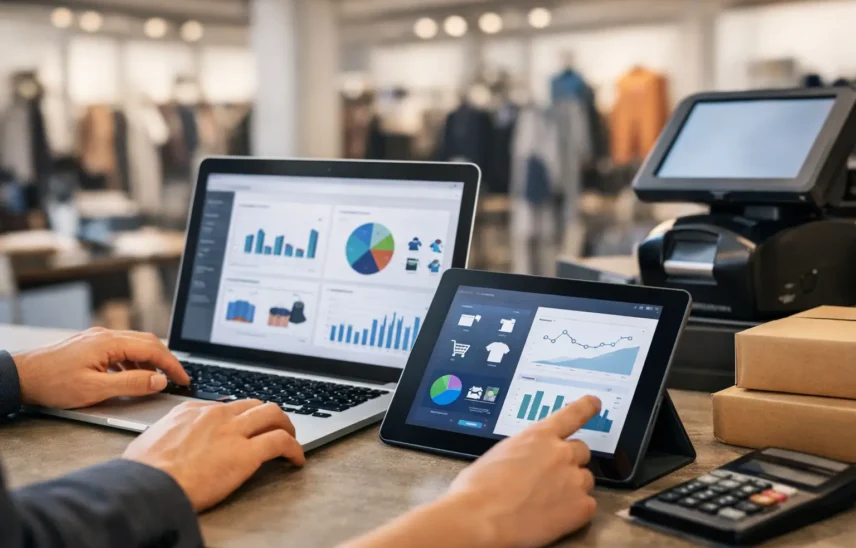
Good systems software helps you answer simple but commercially important questions without delay. What is selling well? What is sitting too long? Which locations are underperforming? What needs reordering? Where are returns increasing? If the answers depend on pulling reports from several places and checking them manually, the business is running harder than it needs to.
Many SMEs begin with a practical mix of accounting software, EPOS, spreadsheets and separate ordering processes. That is understandable. Early on, cost and speed matter more than perfect integration.
The problem starts when growth exposes all the manual work hiding behind that setup. A second site opens. Ecommerce volume increases. Product ranges expand. More suppliers come on board. Suddenly, what felt lean starts creating delays, duplicated data and avoidable errors.
This is where trade-offs become obvious. Standalone tools can be cheaper upfront and may look simple on paper. But they often cost more over time in labour, rework and missed visibility. An integrated platform usually needs more planning at the start, but it gives the business a better base for control and growth.
That does not mean every retailer needs a large, complex ERP from day one. It does mean businesses should be honest about how much operational drag they are tolerating. If your team is spending hours correcting stock, manually reconciling sales, or emailing updates between departments, the software is no longer supporting the business properly.
Retail business systems software should reflect how your operation really works, not how a vendor wishes it worked. For most retailers, there are a few functions that matter more than flashy features.
Stock control is usually near the top of the list. You need confidence that inventory figures are current, accurate and visible across locations and sales channels. That includes incoming stock, reserved items, returns and transfers. Poor stock control creates problems in every direction – cash tied up in the wrong lines, stockouts on best-sellers, and frustrated customers who were told an item was available when it was not.
Order management matters just as much. Whether you sell in-store, online, wholesale or through a mix of channels, orders should move through one controlled process. That means fewer manual handoffs and a clearer view of fulfilment status, delays and exceptions.
Finance integration is another area where many retailers struggle. If your sales data and stock movements are not feeding into finance accurately, month-end becomes harder than it should be. Teams lose time checking figures rather than using them. Better integration reduces admin and gives leadership more confidence in the numbers.
Customer information also deserves proper attention. Retailers often have useful data scattered across EPOS, ecommerce, marketing tools and service inboxes. A joined-up system helps teams respond faster, personalise communication sensibly and see the full customer relationship rather than isolated transactions.
Choosing a system should not start with a product demo. It should start with your processes.
The right first step is mapping how work currently flows through the business. How does a product get ordered, received, sold, returned and reported on? Where are staff rekeying data? Where do delays happen? Where do errors happen more often than they should? Without that view, it is too easy to buy software that looks impressive but solves the wrong problems.
The next step is deciding what must improve in measurable terms. That might be reducing stock discrepancies, speeding up order processing, improving reporting accuracy or cutting the time spent on monthly reconciliations. Clear outcomes make it easier to judge software honestly.
It also helps to separate essentials from preferences. Some features feel attractive during procurement but add little value in practice. Others sound less exciting yet make a major operational difference. Mobile access, role-based permissions, audit trails and dependable reporting may not sell the dream, but they often matter more than decorative dashboards.
Support should be part of the decision, not an afterthought. Even the best system will fail to deliver if implementation is rushed, training is poor or nobody takes responsibility once it goes live. For SMEs especially, accountability matters. You need a partner who can explain the trade-offs clearly, configure the system around your processes, and stay involved when issues need fixing.
One common mistake is buying for the business you hope to become while ignoring the one you have now. Ambition is useful, but systems still need to work with current staffing levels, data quality and operational discipline. If a platform is too complicated for your team to use consistently, adoption suffers and benefits are delayed.
Another mistake is underestimating migration. Old data is rarely clean. Product codes may be inconsistent, customer records duplicated, and historic stock information unreliable. A smooth move depends on proper preparation, not optimism.
Retailers also get caught out by focusing purely on licence cost. Software pricing matters, but the bigger question is total operational value. A cheaper option that needs more manual work, more bolt-ons and more troubleshooting is not necessarily the better commercial choice.
Cybersecurity should not be overlooked either. Retail businesses handle sensitive customer and payment-related data, and they often work across multiple devices, users and sites. Any new platform should support strong access controls, sensible permissions and secure hosting. Efficiency without resilience is a poor bargain.
For many SMEs, the challenge is not choosing from a shortlist. It is having the time and expertise to evaluate systems properly while keeping the business moving.
That is where a managed technology partner can add real value. The right partner will look beyond software features and focus on operations, risk and support. They will ask how your teams work, what breaks most often, what needs integrating, and what success should look like six months after launch. That approach tends to produce better decisions than a feature race.
It also reduces the usual handoff problem. Retailers often end up with separate providers for IT support, software implementation, security and communications, which makes ownership unclear when something goes wrong. A joined-up approach gives you one accountable relationship and a clearer route from planning to rollout to ongoing support.
For businesses around London and across the wider UK, that matters more than ever. Retail operations do not have much patience for downtime, supplier finger-pointing or support queues. They need systems that work and people who take responsibility when they do not.
There is no perfect system for every retailer. A single-site shop with light stockholding does not need the same setup as a multi-channel operation with warehousing, fulfilment complexity and supplier lead times to manage. It depends on your size, your processes and how fast the business is changing.
What does stay consistent is the need for control. Retail business systems software should give you a more accurate view of the business, reduce avoidable admin, and help your team spend more time serving customers and less time chasing data. If it cannot do that in practical day-to-day terms, it is not the right fit.
The best time to review your systems is before the next stage of growth turns minor inefficiencies into expensive habits. Get the foundations right, and the business becomes easier to run, easier to protect and easier to scale with confidence.